
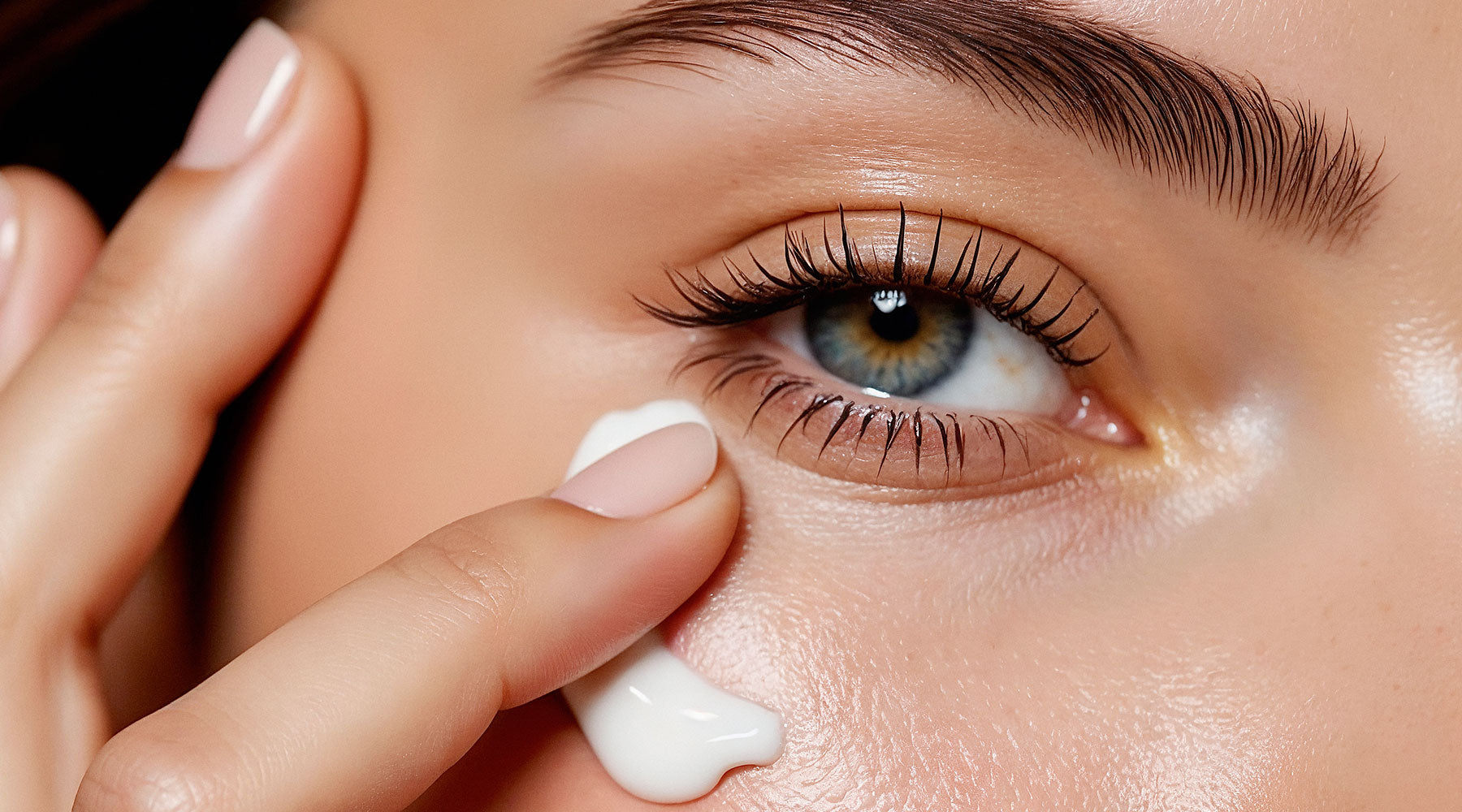
Eye Oil vs Eye Cream: Why We Formulated Illume Without Water
Eye creams and eye oils are often placed in the same category, but they work in different ways.
A traditional eye cream is usually an emulsion: a blend of water and oil held together with emulsifiers. A waterless eye oil contains no water phase at all. Instead, it delivers a concentrated layer of lipids directly to the skin.
Neither format is automatically better. The right choice depends on what your skin needs, which ingredients are being delivered and how the formula has been designed.
When we developed the Multi-Use Eye Illume Roller, our goal was not to recreate a conventional eye cream in a smaller bottle. We wanted to create a concentrated lipid treatment for an area that is particularly prone to dryness, visible fatigue and barrier depletion.
The eye area has different needs
The skin around the eyes is thinner and more delicate than much of the skin elsewhere on the face. It is also subjected to constant movement through blinking, smiling and facial expression.
When this area becomes dry or lipid-depleted, fine surface lines can appear more pronounced. Uneven texture can also scatter light irregularly, making hollows and shadows look deeper.
A carefully formulated eye oil does not add water to the skin. Instead, it supplies emollient lipids that soften the surface, support the moisture barrier and help slow the loss of water already present within the skin.
That distinction matters:
Humectants attract and bind water.
Emollients soften and smooth the skin.
Occlusives help reduce moisture loss.
Plant oils function mainly as emollients and moisture-sealing ingredients. This makes them particularly useful when the under-eye area feels dry, tight or depleted.
Waterless does not simply mean “better”
Water is not a cheap or ineffective cosmetic ingredient. In a well-formulated cream, it provides immediate light hydration and creates a delivery phase for water-soluble ingredients such as glycerine, hyaluronic acid, niacinamide and certain peptides.
A water-based cream also requires a supporting formulation system, usually including emulsifiers, preservatives, stabilisers and texture modifiers.
A waterless oil takes a different approach.
Because there is no water phase, the formula can be built almost entirely from lipid-based ingredients. This creates a highly concentrated treatment, but it does not mean that every oil is automatically more effective than every cream.
Performance still depends on the quality of the ingredients, the balance of the formula and whether the format suits the person using it.
Why an oil can soften dryness lines quickly
Fine lines caused or exaggerated by dryness often become more visible when the surface of the skin is rough and uneven.
A lightweight oil spreads across the outer layer of the skin and helps fill some of the microscopic spaces between dry surface cells. This creates a smoother, more uniform lipid layer.
The skin may therefore appear:
- smoother;
- softer;
- less crepey; and
- more luminous.
This is not the same as permanently removing structural wrinkles. It is an immediate surface-conditioning effect, supported over time by better moisture retention and consistent barrier care.
Can an oil really improve hydration?
An oil does not contain water, so it cannot hydrate the skin in the same way as a water-based serum or cream.
However, oils can improve the skin’s moisture level indirectly by supporting the barrier and reducing water loss.
This is particularly relevant to the raspberry oil used in Illume. Supplier efficacy testing measured skin hydration two hours after application and found that the oil increased measured hydration compared with the base-lotion control. The graph also showed greater hydration as the concentration of raspberry oil increased.
The full study methodology and sample size were not provided in the technical overview, so these results are best described as supplier efficacy data rather than an independent clinical trial.
Even with that limitation, the results help illustrate an important point: a waterless oil can support hydration by improving the skin’s ability to retain moisture.
Why fatty acids matter
The oils in Illume were selected for their fatty-acid profiles rather than simply for how luxurious they sound.
Prickly pear seed oil is particularly rich in linoleic acid, an omega-6 fatty acid associated with skin-barrier function and lightweight emolliency.
Raspberry oil contributes a complementary balance of omega-3 and omega-6 fatty acids, as well as naturally occurring vitamin E. The supplier describes it as a nourishing, hydrating and skin-smoothing oil, with data supporting both hydration and antioxidant activity.
Together, these lipids help soften the skin, support barrier condition and reduce the dry texture that can make fine lines and shadows look more noticeable.
What antioxidants can and cannot do
The delicate eye area is continuously exposed to environmental stress.
Antioxidants help protect oils and skin-surface lipids from oxidative damage. Raspberry oil is naturally rich in tocopherols, forms of vitamin E, and the supplier reports that it contains nearly 20% more tocopherols than ordinary raspberry seed oil.
This supports its role as an antioxidant-rich conditioning ingredient.
It does not mean that the oil can erase pigmentation, permanently remove dark circles or reverse structural ageing. Those claims would go beyond the evidence provided.
A more realistic benefit is supportive care: helping to maintain a softer, better-conditioned and more resilient-looking surface.
Eye oil and eye cream do not have to compete
A person does not necessarily need to choose one format forever.
An eye cream may be preferable when you want:
- humectants such as glycerine or hyaluronic acid;
- water-soluble actives;
- a very light daytime texture; or
- easy layering beneath makeup.
An eye oil may be preferable when you want:
- richer lipid replenishment;
- support for tight or dry-feeling skin;
- a concentrated evening treatment;
- additional moisture sealing; or
- a formula that can also be used on lips and other dry areas.
The two formats can also be layered.
A water-based eye product can be applied first, followed by a very small amount of oil to soften the surface and help reduce moisture loss.
More than an eye treatment
Illume was designed primarily for the eye area, but the same lipid blend can also condition lips, cuticles and small dry patches. For hygienic multi-use application, roll the product onto a clean fingertip before applying it anywhere other than the eye area.
The final word
Eye oils and eye creams are not interchangeable, but neither one is inherently superior.
Creams are particularly useful for delivering water, humectants and water-soluble actives. Oils are particularly useful for replenishing lipids, smoothing dry texture and helping the skin retain moisture.
Illume was created for the second purpose: as a concentrated, waterless treatment for dry, delicate areas that need softness, comfort and barrier support.

Written by Ginette Blackbeard